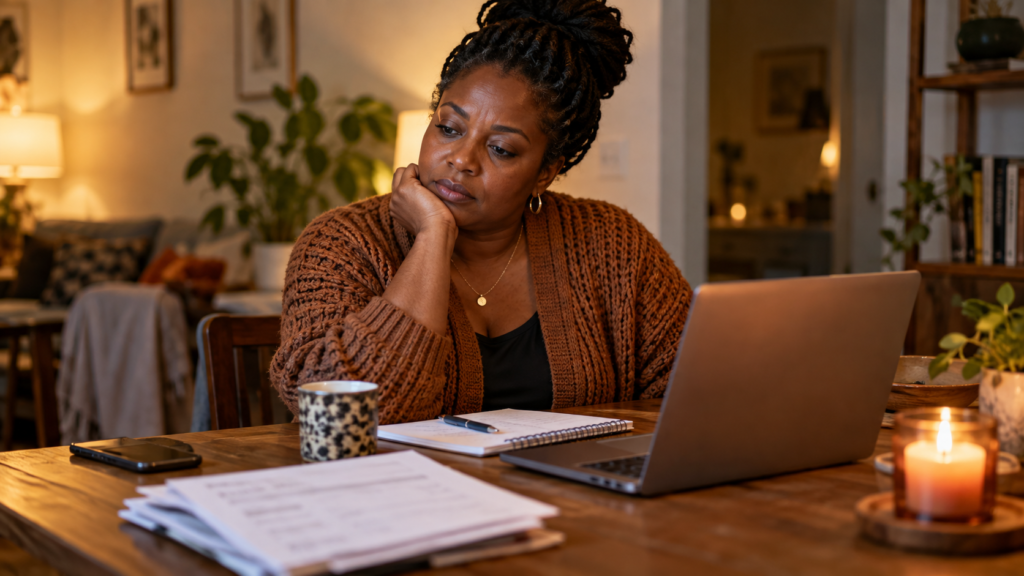

One day, your body just starts acting brand new.
That’s really the best way I know how to say it.
You’re minding your business. Working. Taking care of folks. Trying to drink more water. Trying to go to bed at a decent time. Trying to keep your peace from packing a little overnight bag and leaving the premises.
Then out of nowhere, you’re hot.
Not “somebody turn the air down” hot.
I mean hot hot.
Sweating through your clothes hot. Waking up damp hot. Sitting in a room wondering if everybody else is pretending not to be hot, or if your body has personally decided to betray you.
And because nobody really prepared us for this part, your mind starts doing what minds do when they don’t have enough information.
It starts making up a story.
Maybe something’s wrong with me.
Maybe I’m not taking care of myself.
Maybe I’m just tired.
Maybe I’m lazy.
Maybe I’m losing it.
Maybe this is what falling apart feels like.
That’s why Episode 717 of The Dope Black Chick Podcast feels so necessary.
Because Kimberly finally says the thing a lot of women over 40 have been whispering, Googling, asking in group chats, or quietly worrying about:
What is happening to my body?
I didn’t know how much I needed somebody to name it
In the episode, Kimberly talks about noticing the heat first.
She’d be out speaking, trying to stay present, trying to do what she came to do, and suddenly her body would just start heating up. Sweating. Feeling uncomfortable. Feeling like something was happening that she couldn’t quite explain.
And I felt that.
Because it’s one thing to be hot at home where you can change clothes, turn on a fan, open a window, and sit under the air like it owes you money.
It’s another thing to be hot when you’re out in public.
When you’re speaking.
When you’re working.
When you’re trying to look composed.
When you’re trying not to draw attention to yourself.
When your body is doing the absolute most and you’re trying to act regular.
That will mess with you.
Not just physically, but emotionally.
Because now you’re not only dealing with the symptom. You’re dealing with the self-consciousness that comes with it.
Do people notice?
Am I sweating too much?
Why am I so irritated?
Why am I so tired?
Why does my period feel different?
Why does my body ache like I helped somebody move furniture yesterday and I know good and well I didn’t?
And maybe the biggest question:
Why didn’t anybody tell us this could happen?
We heard about menopause, but not the middle part
Most of us heard about menopause in a very general way.
We knew periods eventually stopped.
We knew somebody’s auntie had hot flashes.
We knew somebody was always fanning herself at church.
We knew “the change” was out there somewhere.
But perimenopause?
The years before menopause, when your hormones can start shifting while you’re still having periods, still working, still mothering, still caregiving, still building, still dating, still praying, still trying to be somebody’s reliable person?
A lot of us didn’t get language for that.
So let’s say it plainly.
Perimenopause is the transition leading up to menopause. During this season, hormone levels can shift, and some women experience symptoms like hot flashes, night sweats, sleep changes, and irregular periods. Office on Women’s Health
That doesn’t mean every woman will experience it the same way.
Some women barely notice it. Some women get symptoms that come in like they’ve got a key to the house. Some women feel it mostly in their body. Some feel it in their mood. Some don’t realize what was happening until they look back and connect the dots.
But the point is, there are dots to connect.
And too many of us were left trying to connect them by ourselves.
When nobody tells you what’s happening, shame fills in the blank
This is the part that stuck with me from the episode.
Kimberly said something that landed deep: when you don’t understand why something is happening, you can start making it mean something about who you are.
That’s it.
That’s the whole thing.
Because when your body changes and you don’t know why, you don’t just think, “My body is changing.”
You start thinking:
I’m not disciplined enough.
I’m not taking care of myself.
I’ve let myself go.
I’m too emotional.
I’m too tired.
I’m not who I used to be.
I should have this under control by now.
And listen, some of us have been trained to make everything our fault.
We’re so used to managing, fixing, carrying, planning, pushing, and performing that even when our bodies are asking for care, we hear it as criticism.
That’ll preach, but let’s not pass the offering plate yet.
Maybe your body isn’t accusing you.
Maybe it’s informing you.
Maybe it’s saying, “Something’s shifting, and I need you to pay attention.”
Black women deserve better than “just push through”
This conversation matters for all women, but it hits differently for Black women.
Because so many of us were raised, praised, or pressured into pushing through everything.
Push through pain.
Push through exhaustion.
Push through grief.
Push through disappointment.
Push through bad sleep.
Push through the meeting.
Push through the family stuff.
Push through the church obligation.
Push through the job that keeps asking for your whole nervous system on a Tuesday.
So when your body starts changing after 40, it can feel like betrayal.
Not because your body is wrong.
Because the old way of pushing may not work anymore.
And Black women need more honest conversations about this. Research from the Study of Women’s Health Across the Nation, also known as SWAN, has found that hot flashes and night sweats can last for years, and SWAN has reported longer average duration of these symptoms among Black women compared with some other racial groups in the study. Swan Study
That matters.
If we’re more likely to deal with certain symptoms for longer, then we need more language, not less. More support, not silence. More doctors who listen, not more “you’re too young” energy.
Because being dismissed while your body is changing can make you feel like you’re imagining things.
And you’re not.
The group chat might be where the truth shows up first
One of the most relatable parts of Kimberly’s story was when she started looking around at her friends and realizing they were all hot.
Everybody around the same age.
Everybody wondering what was going on.
Everybody comparing notes.
That’s how so many of us find out what’s happening.
Not from a pamphlet.
Not from a doctor’s office.
Not from some formal sit-down where someone explains midlife body changes with a sensible handout and compassion.
Nope.
We find out because somebody says, “Girl, are you hot all the time too?”
And then the whole chat lights up.
That’s why we need to talk about this out loud.
Not because the group chat replaces medical care. It doesn’t.
But because sometimes the group chat gives you the courage to stop dismissing yourself.
Sometimes hearing another woman say, “That happened to me too,” is what helps you make the appointment, ask the better question, track your symptoms, or stop calling yourself crazy.
Start noticing without spiraling
Now, this isn’t medical advice. If something feels intense, unusual, disruptive, or concerning, please talk to a healthcare provider.
And if your period changes dramatically, if bleeding is very heavy, or if something feels off in a way that worries you, don’t just suffer through it. The FDA advises talking with a healthcare provider about changes in periods or bleeding. U.S. Food and Drug Administration
But one gentle thing you can do is start paying attention.
Not obsessing.
Not panicking.
Not turning your Notes app into a detective board with red string and mugshot energy.
Just noticing.
You can write down:
- when you feel hot or sweaty
- what your sleep is doing
- whether your period has changed
- when your mood feels sharper or lower than usual
- whether your body aches feel new
- what you want to ask your doctor
- what your friends are saying they’ve noticed too
Because sometimes the first power move is being able to say:
“This is what changed.”
“This is what I noticed.”
“This is what I’m experiencing.”
“This is why I need you to listen.”
That’s not being dramatic.
That’s being clear.
Maybe the question isn’t “What’s wrong with me?”
The more I sit with this conversation, the more I think the question has to change.
Instead of:
“What’s wrong with me?”
Maybe we ask:
“What is my body navigating right now?”
Instead of:
“Why can’t I push through like I used to?”
Maybe we ask:
“What support does this season require?”
Instead of:
“Am I falling apart?”
Maybe we ask:
“What information have I been missing?”
Because maybe you’re not falling apart.
Maybe you’re entering a season nobody explained well enough.
Maybe your body is changing, your needs are changing, your energy is changing, and your old way of overriding yourself isn’t working anymore.
That doesn’t mean you’re weak.
It might mean you’re being invited into a different relationship with your body.
One with more listening.
More honesty.
More tenderness.
More support.
And yes, probably more fans. Let’s not be unrealistic in these streets.
Episode 717 is the conversation we needed
Episode 717 of The Dope Black Chick Podcast is the conversation I want every woman over 40 to hear.
Not because it has every answer.
Because it names the thing.
It names the confusion.
It names the heat.
It names the shame spiral.
It names how easily we can start making body changes mean something is wrong with us.
And sometimes being named is the beginning of being free.
If you’re over 40 and your body has started feeling unfamiliar, this episode is for you.
If you’ve been wondering why you’re hot, tired, achy, irritated, sweaty, emotional, or just not feeling like yourself, this episode is for you.
If you’ve ever sat there thinking, “Is it just me?” I need you to know it’s not.
It’s not just you.
And you’re not crazy.
Listen to Episode 717 of The Dope Black Chick Podcast here.
Stay close to this conversation
At I Hear That Girl, we’re talking about the seasons women are actually living through.
The body changes.
The friendship changes.
The career shifts.
The faith questions.
The identity changes.
The quiet moments when you realize the old version of your life doesn’t fit the same way anymore.
If this felt like somebody finally said what you’ve been trying to explain, join the I Hear That Girl email list.
Not for more noise.
For honest words that meet you in the season you’re actually in.